
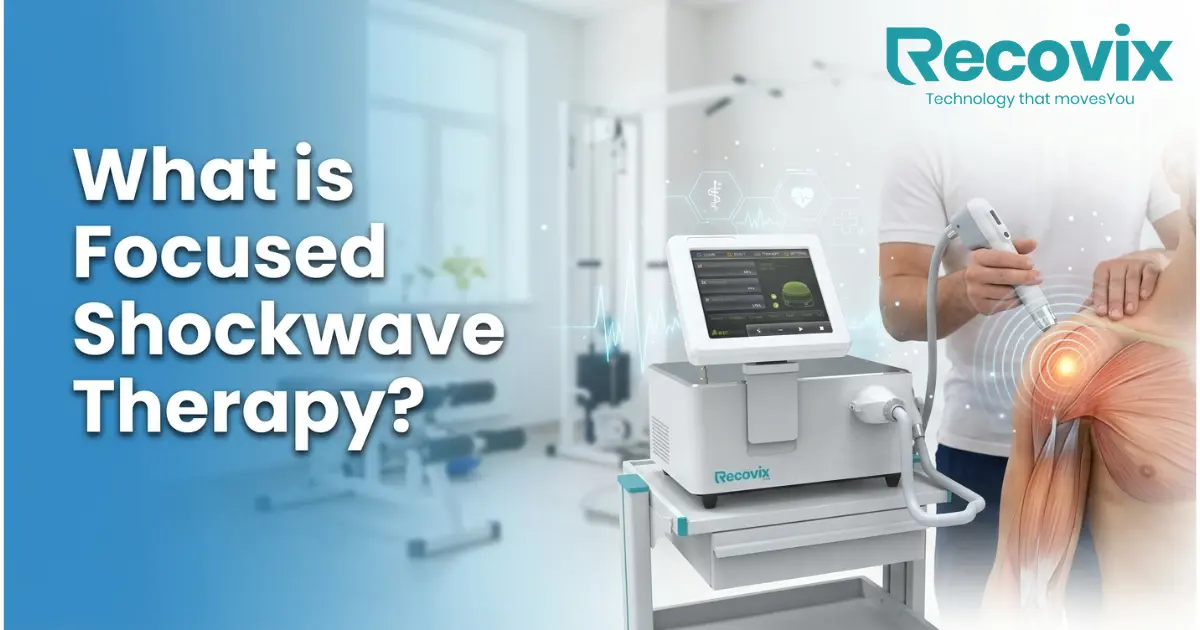
If you’ve spent any time in a physiotherapy clinic lately, you’ve probably noticed a shift. Fewer patients are being told to “just rest it and see.” More are being offered a treatment that sounds almost futuristic: shockwave therapy. And within that category, one technology keeps coming up in conversations among clinicians who treat stubborn tendon and joint pain – focused shockwave therapy.
This isn’t a passing trend. Focused shockwave therapy has become one of the most reliable non-invasive options for chronic musculoskeletal pain, and rehabilitation clinics are adopting it at a steady pace because it actually delivers results patients can feel within a handful of sessions. But what exactly is it, how does it work, and why is it different from the radial devices you might already have in your treatment room? Let’s break it down in plain language.
Understanding Focused Shockwave Therapy
Focused shockwave therapy uses acoustic energy — pressure waves, not sound waves in the traditional sense — that are generated electromagnetically, electrohydraulically, or piezoelectrically and then directed to converge at a specific point beneath the skin. That convergence is the defining feature. Unlike radial devices, which disperse energy outward from the applicator tip and lose intensity as it travels through tissue, focused systems concentrate their energy at a precise depth, sometimes several centimeters below the surface.
This matters clinically. A lot of the conditions physiotherapists treat every day – calcific tendinitis in the shoulder, deep hip pain, or chronic plantar fasciitis — sit below layers of muscle, fascia, and fat. A treatment that can’t reach that depth with meaningful intensity simply won’t produce the biological response needed for lasting change. Focused ESWT (extracorporeal shockwave therapy) was designed to solve exactly that problem.
It helps to think of focused shockwaves the way you’d think of a magnifying glass concentrating sunlight into a single point. The energy isn’t stronger overall — it’s just aimed with precision, so the effect is concentrated exactly where the pathology lives.
How Does Focused Shockwave Therapy Work?
The mechanism is more logical than it sounds once you walk through it step by step.
Energy generation. The device generates a high-pressure acoustic pulse using one of the focused technologies mentioned earlier — most commonly electromagnetic generation in modern clinical units.
Focused delivery. That pulse is channeled through a reflector or lens so the wave converges at a defined focal point and depth, rather than spreading across the surface tissue.
Tissue stimulation. When the wave reaches the target tissue, it creates a mechanical stress on cells. This is what triggers the biological cascade that makes shockwave therapy effective — not heat, and not electrical stimulation, but mechanical force applied in a controlled, repeatable way.
Improved blood circulation. The mechanical stimulation prompts local vasodilation and encourages the growth of new capillaries, a process known as neovascularization. More blood flow means more oxygen and nutrients reaching tissue that’s been chronically under-supplied.
Cellular regeneration and collagen production. Fibroblast activity increases, and with it, collagen synthesis — a critical part of repairing degenerated tendon tissue, which is often the actual problem in “tendinitis” that never seems to fully heal.
Pain reduction. Shockwaves are believed to affect pain signaling by temporarily overstimulating nociceptors and altering substance P levels, which is part of why many patients report noticeable pain relief even after the first couple of sessions.
Healing response. Together, these effects essentially restart a stalled healing process, converting a chronic, low-grade injury into one that behaves more like an acute injury the body knows how to repair.
Conditions Treated with Focused Shockwave Therapy
Because focused energy can reach deeper structures with precision, it’s particularly well suited to conditions where the pathology sits below superficial tissue layers. Clinics commonly use it for:
- Plantar fasciitis
- Tennis elbow (lateral epicondylitis)
- Golfer’s elbow (medial epicondylitis)
- Achilles tendinopathy
- Rotator cuff injuries
- Patellar tendinitis (“jumper’s knee”)
- Calcific shoulder tendinitis
- Chronic hip pain
- Myofascial trigger points
- Persistent, chronic muscle pain that hasn’t responded to standard manual therapy
Calcific shoulder tendinitis is a good example of why depth matters. The calcium deposits associated with this condition typically sit deep within the rotator cuff tendon, an area that’s genuinely difficult to influence with surface-level modalities. Focused shockwave energy can be directed precisely at that deposit, which is one reason it’s become a preferred option among orthopedic and sports medicine specialists for this specific diagnosis.
Focused Shockwave Therapy vs Traditional Treatments
Patients dealing with chronic tendon or joint pain often arrive at a clinic having already tried pain medication, a steroid injection, or months of manual therapy with limited lasting improvement. Focused shockwave therapy offers a different path.
Compared with pain medication, it addresses the underlying tissue changes rather than masking discomfort. Compared with steroid injections, it doesn’t carry the same risk of tendon weakening with repeated use. Compared with surgery, it’s non-invasive, requires no anesthesia, and comes with essentially no downtime — patients typically walk out and resume normal activity the same day. And compared with standard ultrasound therapy, the depth and intensity of energy delivery tend to produce more consistent, evidence-supported outcomes for chronic tendinopathies.
None of this means focused shockwave therapy replaces every other tool in a clinician’s kit — manual therapy, strengthening protocols, and load management still matter enormously. But as an added modality, it gives practitioners a genuinely non-invasive way to accelerate recovery in cases that have plateaued.
If you’re deciding between device types for your own clinic, it’s worth reading through this comparison of focused vs radial shockwave therapy before committing, since the right choice really does depend on the conditions you treat most often.
Who Can Benefit from Focused Shockwave Therapy?
Focused shockwave therapy tends to suit a fairly broad patient population, including:
- Athletes managing overuse injuries who need to return to training without prolonged downtime
- Active adults dealing with tendon pain that’s interfering with daily movement
- Older adults with chronic joint or heel pain who may want to avoid injections or surgery
- Patients with long-standing musculoskeletal pain that hasn’t responded to conservative care
- Orthopedic rehabilitation patients recovering from injury or post-surgical stiffness
- Sports rehabilitation programs looking to shorten recovery timelines
As always, a proper clinical evaluation should determine candidacy. Focused shockwave therapy isn’t appropriate for every presentation — pregnant patients, individuals with certain bleeding disorders, and those with active infections at the treatment site are typically excluded, and any clinic offering this treatment should have clear screening protocols in place.
Choosing the Right Focused Shockwave Therapy Machine
For clinics considering an investment in this technology, the equipment itself matters just as much as the technique. A few factors worth evaluating carefully:
- Energy levels — the range of intensity the device can produce, since different conditions require different energy densities
- Treatment depth — how far the focused energy can effectively penetrate without losing therapeutic intensity
- Frequency settings — flexibility to adjust pulse frequency for patient comfort and treatment goals
- Preset protocols — built-in settings for common conditions that reduce guesswork for newer staff
- User-friendly interface — intuitive controls that don’t require extensive retraining
- Safety certifications — proper regulatory clearance and documented safety testing
- Reliability — consistent output over thousands of treatment cycles
- Clinical versatility — the ability to treat a wide range of conditions with one device
These are exactly the kinds of details covered in more depth in our Shockwave Therapy Machine Buying Guide, which walks through how to compare specifications across different manufacturers before making a purchase.
Why Clinics Are Investing in Focused Shockwave Therapy Machines
From a business standpoint, the appeal is straightforward. Adding focused shockwave therapy expands what a clinic can offer without requiring additional square footage or a large increase in staffing. It gives practitioners another evidence-supported option for patients who’ve plateaued with standard care, which tends to translate into better patient satisfaction and stronger retention.
There’s also an efficiency argument. Sessions are typically short — often 10 to 15 minutes — which allows clinics to treat more patients without extending appointment slots. And because focused shockwave therapy addresses conditions that are otherwise difficult to resolve conservatively, clinics that offer it often see themselves become a referral destination for physicians managing chronic tendinopathy cases.
For clinics ready to explore this technology, it’s worth looking at a professional focused shockwave therapy machine built for consistent clinical use rather than a lower-powered consumer-grade device that may not deliver the depth or intensity needed for real therapeutic effect.
Conclusion
Focused shockwave therapy offers an evidence-based, non-invasive solution for treating chronic musculoskeletal conditions that have resisted more conservative approaches. Its ability to deliver concentrated acoustic energy to precise depths makes it especially useful for deep-seated issues like calcific tendinitis, rotator cuff injuries, and stubborn plantar fasciitis.
For clinics looking to expand their advanced rehabilitation services, investing in a professional focused shockwave therapy machine can improve treatment outcomes, increase patient satisfaction, and support long-term clinical growth. Before making a purchasing decision, it’s worth taking the time
to review the full buying guide so you choose equipment that genuinely fits your patient population and treatment goals.
As with any medical treatment, patients should consult a qualified healthcare professional to determine whether focused shockwave therapy is appropriate for their specific condition.