
Walk into any physiotherapy clinic in Chennai, Coimbatore, or Madurai today, and you’ll notice something has changed. Patients aren’t just asking for hot packs and ultrasound anymore. They’re asking specifically about shockwave therapy, because they’ve read about it, heard about it from a fellow patient, or seen a fitness influencer mention it. That shift in patient awareness is exactly why more clinic owners across Tamil Nadu are now trying to decide between a focused and a radial shock wave physiotherapy machine, and honestly, this is one of the most common questions we hear.
The truth is, both machines are excellent. Neither one is “better” in a general sense. What matters is which one fits the conditions you treat most often, the patients who walk through your door, and where you want your clinic to be in the next few years. If you haven’t already, it’s worth reading our complete buying guide first, since this article builds directly on the fundamentals covered there. Consider this the practical, side-by-side comparison to help you make a confident decision.
Focused vs Radial Shockwave Therapy
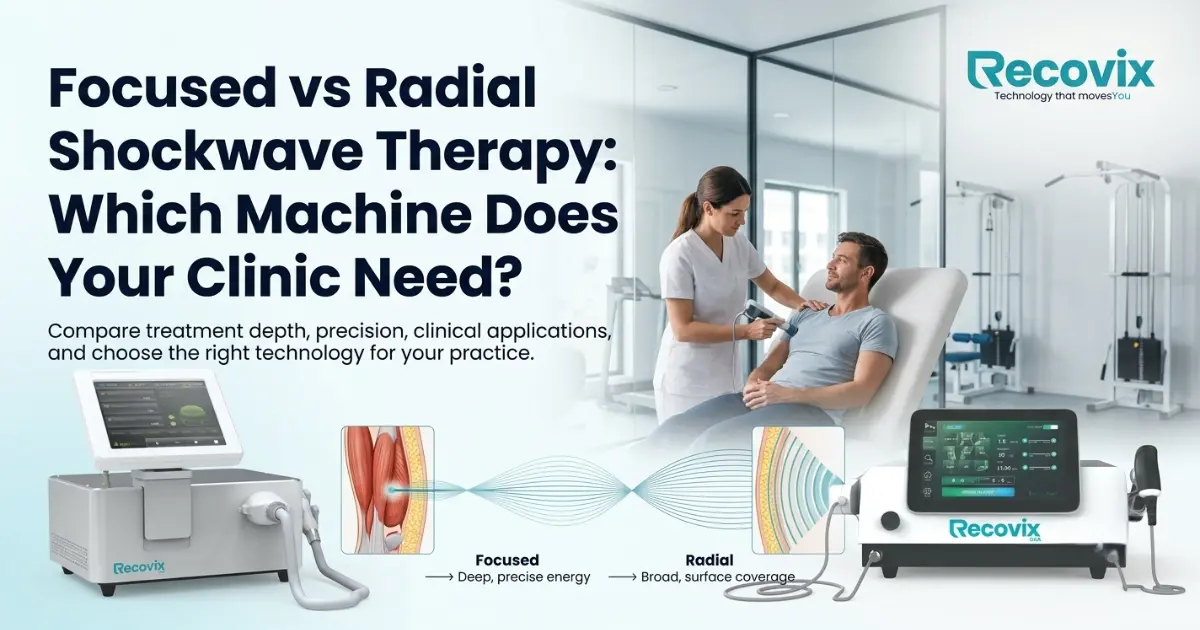
The core difference comes down to how the energy is generated and how deep it travels into tissue. A focused shockwave machine creates a concentrated energy wave that converges at a specific point beneath the skin, allowing precise targeting of deeper structures. A radial shockwave machine, on the other hand, produces a pressure wave that disperses outward from the applicator tip, covering a broader surface area but at a shallower depth.
Here’s how the two typically compare in a clinical setting:
| Factor | Focused Shockwave | Radial Shockwave |
|---|---|---|
| Energy delivery | Concentrated, converges at a target depth | Dispersed, radiates outward from contact point |
| Treatment depth | Reaches deeper tissue (up to 12 cm) | Best for superficial tissue (2–4 cm) |
| Precision | High, ideal for pinpoint targeting | Moderate, covers a wider treatment zone |
| Patient comfort | Can feel more intense at higher energy | Generally gentler, better tolerated |
| Best applications | Calcific tendinitis, deep tendon disorders | Trigger points, myofascial pain, general soft tissue |
| Treatment area | Small, localized | Larger, spread-out areas |
| Recovery expectations | Often fewer sessions for deep conditions | May require more frequent sessions |
| Typical users | Orthopedic and sports medicine clinics | General physiotherapy and rehab clinics |
| Cost considerations | Usually a higher upfront investment | Often more budget-friendly to start |
Neither column is inherently superior. It genuinely depends on your patient mix.
Which Shockwave Machine Is Best for Your Clinic?
If your practice sees a steady stream of athletes, or you regularly treat conditions like calcific shoulder tendinitis, chronic Achilles tendinopathy, or deep-seated plantar fasciitis that hasn’t responded to conservative care, a Focused Shockwave Therapy Machine is often the more clinically appropriate choice. Sports medicine clinics and orthopedic-focused centers commonly prefer focused systems because they allow clinicians to target the exact site of injury with far greater accuracy.
If your clinic’s daily caseload leans more toward general physiotherapy, tennis elbow, muscular trigger points, or soft tissue pain that spans a broader area, a Radial Shockwave Therapy Machine tends to be more practical. It’s also gentler for patients who are anxious about intensity, which matters a lot when you’re building trust with a new patient in a busy outpatient setting.
Here’s something worth knowing: many mid-sized and growing clinics in India eventually invest in both systems. As patient volume grows and case variety expands, having a radial physiotherapy machine for everyday soft tissue work alongside a focused shockwave equipment setup for complex tendon cases gives clinicians the flexibility to treat almost anything that walks in the door, without referring patients elsewhere.
Factors to Consider Before Buying
Before you finalize your purchase, it helps to think beyond just the machine’s specifications.
- Budget and ROI: A radial shockwave system usually has a lower entry cost, which matters for clinics just starting out or expanding into a second location.
- Patient volume: Higher patient turnover often justifies investing in equipment that can treat a wider range of conditions efficiently.
- Conditions you treat most: Be honest about your actual caseload rather than the caseload you hope to have someday.
- Future expansion plans: If you’re planning to bring in a sports medicine specialist or expand into orthopedic rehab, factor that into your decision now.
- Clinic specialization: A hospital rehab department has different needs than a boutique sports recovery studio.
- Staff training: Ensure your team is comfortable with the learning curve, especially for focused systems that require more precise handling.
- Maintenance and manufacturer support: Ask about warranty terms, spare parts availability in India, and how quickly a technician can respond if the machine needs servicing.
These practical details often matter just as much as the clinical specifications when it comes to long-term satisfaction with your purchase.
Final Thoughts
There’s no single right answer here, only the right answer for your clinic. A focused shockwave machine rewards you with precision and depth for complex, chronic conditions, while a radial shockwave machine offers versatility and comfort for everyday physiotherapy work. Many clinicians across Tamil Nadu and the rest of India are finding that understanding their own patient base, rather than chasing the latest trend, leads to the smartest equipment decisions.
Before you make your final call, take a few minutes to explore both the Focused Shockwave Therapy Machine and Radial Shockwave Therapy Machine product pages, and revisit our complete buying guide for a deeper look at pricing, certifications, and after-sales support. Choose equipment based on what your patients actually need, not just what fits the budget on paper.