
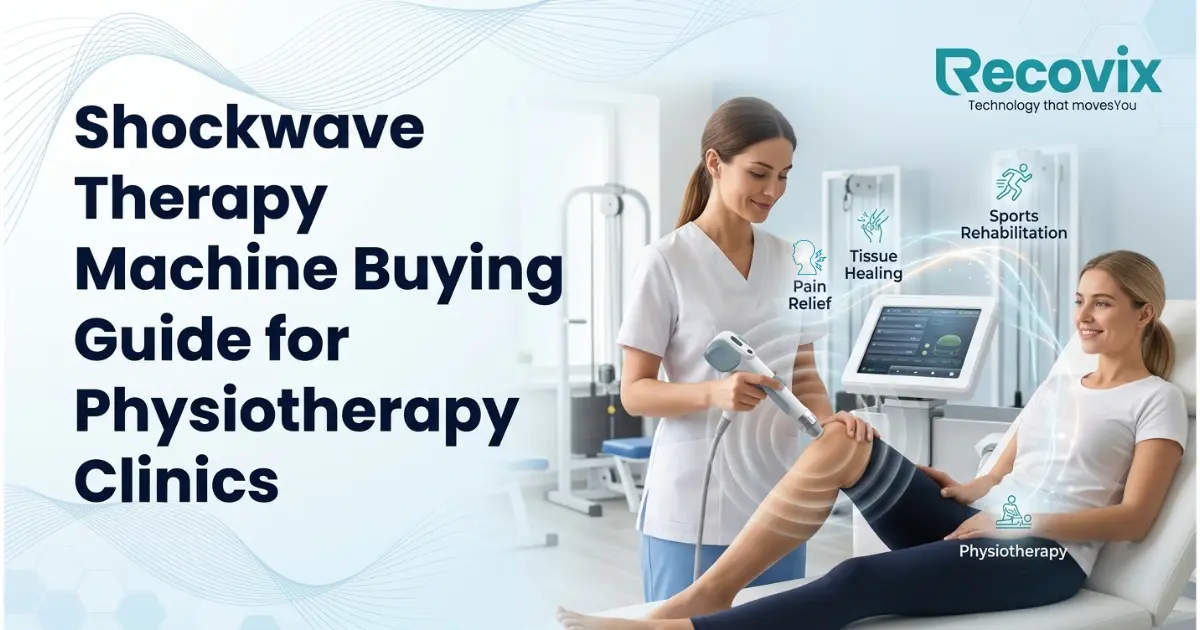
Choosing the right shockwave therapy machine can significantly impact your clinic’s treatment outcomes, patient satisfaction, and revenue.
But with so many options in the market-focused systems, radial devices, low-cost imports, and premium clinical machines-how do you decide what actually fits your practice?
If you run a physiotherapy clinic, sports rehab center, chiropractic practice, or hospital rehabilitation department, this guide will help you make an informed decision based on clinical outcomes, technical specifications, and return on investment (ROI).
At RecovixUSA, we help clinics evaluate advanced physiotherapy equipment based on treatment goals-not marketing hype.
Ready to upgrade your clinic?
Book a free demo with RecovixUSA and let our specialists help you choose the right machine.
What Is Shockwave Therapy?
Shockwave therapy, also called Extracorporeal Shockwave Therapy (ESWT), is a non-invasive treatment that uses high-energy acoustic waves to stimulate tissue repair, reduce chronic pain, and accelerate healing.
In simple terms, the machine delivers mechanical pulses into injured tissues. These pulses create biological responses that support recovery.
Key therapeutic effects include:
- Pain modulation through nerve desensitization
- Neovascularization (formation of new blood vessels)
- Improved cellular metabolism
- Breakdown of calcifications
- Enhanced collagen production
- Tendon and soft tissue regeneration
This is why shockwave therapy is widely used for chronic musculoskeletal conditions that fail to respond to conventional treatment.
Compared with repeated corticosteroid injections, ESWT often provides better long-term outcomes because it addresses healing – not just temporary pain suppression.
Common applications include:
- Physiotherapy clinics treating chronic pain
- Sports rehab centers managing overuse injuries
- Chiropractic clinics treating soft tissue dysfunction
- Orthopedic rehabilitation departments
Typical conditions treated include:
- Plantar fasciitis
- Tennis elbow
- Achilles tendinopathy
- Patellar tendon pain
- Rotator cuff disorders
- Trigger points
- Calcific shoulder pain
For clinics looking to expand high-value services, a professional shockwave therapy machine can become both a clinical and financial asset.
Focused vs Radial Shockwave Therapy (Core Decision)
This is the biggest buying decision.
When clinics want to buy shockwave therapy machine systems, they usually compare two technologies:
- Focused shockwave therapy machine
- Radial shockwave therapy machine
Understanding the difference prevents expensive mistakes.
Focused Shockwave Therapy
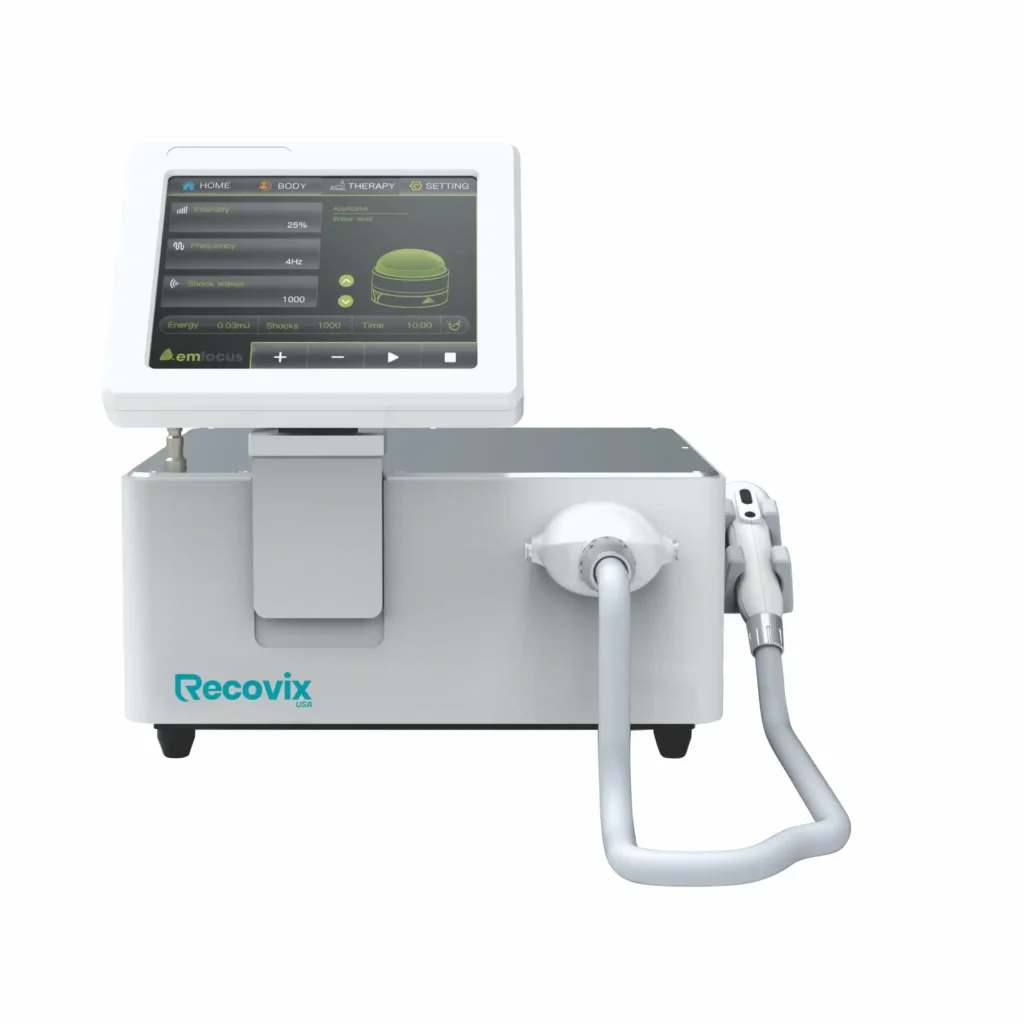
A focused shockwave therapy machine delivers concentrated acoustic energy into a precise target area at controlled depths.
RecovixUSA’s Focused Shockwave (FCS) system features:
- 0–65 mm penetration depth
- Electromagnetic technology
- Precise energy delivery
- No gel pads required
- High-energy targeting for deep tissues
Because energy converges at a focal point, focused systems are ideal for deeper pathology.
Best for:
- Calcific tendinopathy
- Deep tendon injuries
- Chronic tendinopathies
- Delayed healing tissue
- Bone stress conditions
- Non-union fractures
Focused systems are especially valuable in advanced rehabilitation clinics handling chronic orthopedic cases.
Radial Shockwave Therapy
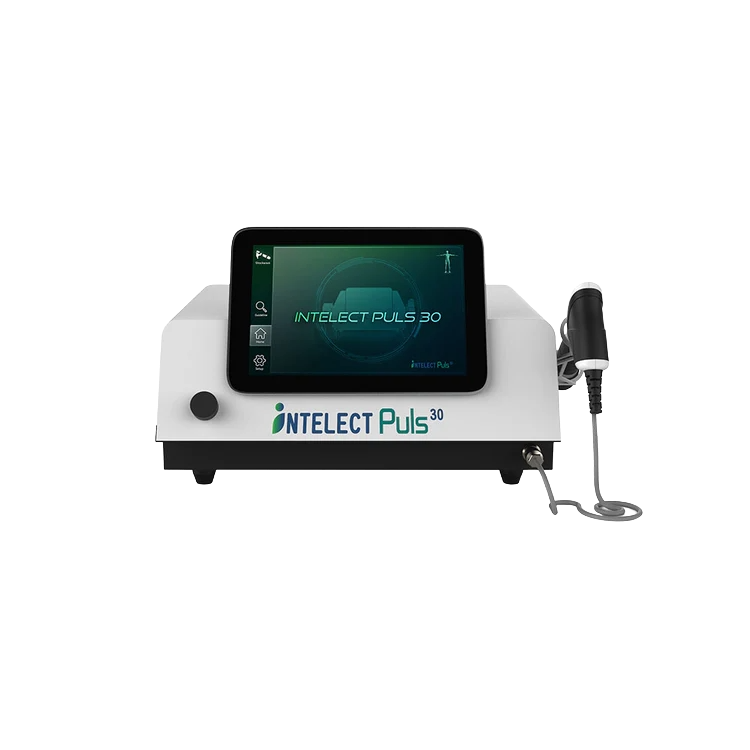
A radial shockwave therapy machine generates pressure waves pneumatically.
Instead of converging energy deeply, radial systems spread energy across a broader surface area.
RecovixUSA’s Radial Shockwave (RDS) system offers:
- Pneumatic wave generation
- Broad tissue coverage
- Adjustable frequency
- Adjustable energy output
Best for:
- Myofascial pain
- Trigger points
- Muscle tightness
- Sports recovery
- Superficial tendinopathy
Radial devices are excellent for high-volume clinics with general orthopedic or sports patients.
Focused vs Radial Comparison Table
| Parameter | Focused | Radial |
| Mechanism | Electromagnetic | Pneumatic |
| Penetration Depth | 0–65 mm | Superficial to moderate |
| Energy Delivery | Concentrated focal point | Broad dispersive pressure |
| Best Indications | Deep tendon, calcific lesions | Muscle, fascia, trigger points |
| Treatment Area | Precise | Wider |
| Clinic Fit | Advanced rehab / orthopedic | General physio / sports |
| Recovix Model | FCS | RDS |
Quick Decision Framework
Use this practical rule:
If your clinic mainly treats chronic deep tendon injuries → Choose focused.
Examples:
- Calcific shoulder
- Chronic Achilles tendinopathy
- Patellar tendinopathy
- Bone healing support
Choose focused shockwave therapy machine.
If your clinic mainly treats muscular pain and sports recovery → Choose radial.
Examples:
- Trigger points
- Tight calves
- Muscle soreness
- Myofascial dysfunction
Choose radial shockwave therapy machine.
Some advanced clinics invest in both to cover a wider caseload.
5 Technical Specs That Matter Before Buying
Many buyers compare only price.
That’s a mistake.
Here are the technical specs that truly matter.
1. Penetration Depth
Not all machines deliver meaningful therapeutic depth.
Focused systems like Recovix FCS offer:
0–65 mm penetration
This matters for:
- Deep gluteal tissue
- Hip structures
- Thick tendons
- Deep shoulder lesions
Shallow machines may underperform in these cases.
2. Energy Output
Energy determines treatment intensity.
For focused systems, compare:
- mJ/mm² (energy flux density)
For radial systems, compare:
- Bar pressure
Higher numbers alone aren’t enough.
Look for:
- Stable delivery
- Accurate calibration
- Consistent energy under load
Cheap devices often show inflated numbers.
3. Frequency Range
Frequency affects treatment speed and patient comfort.
Good systems should offer:
1–22 Hz adjustable frequency
Lower frequencies:
- Better for sensitive patients
Higher frequencies:
- Faster sessions
- Better workflow
High-volume clinics benefit from wider frequency control.
4. Thermal Management & Duty Cycle
This is overlooked-and critical.
Low-cost machines often overheat during back-to-back sessions.
Problems include:
- Reduced energy output
- Forced cooldown periods
- Shorter machine lifespan
- Session interruptions
Premium machines use advanced cooling systems to maintain performance.
Recovix systems feature enhanced thermal management for busy clinics.
5. Touchscreen & Built-In Protocols
Workflow efficiency matters.
Modern machines should include:
- Guided protocols
- Preset body areas
- Adjustable parameters
- Clinical recommendations
A large touchscreen reduces training time and improves staff adoption.
Machines with smart protocols help therapists deliver consistent treatment.
Ready to compare machines side by side?
Book a free demo and let RecovixUSA walk you through the specs.
Conditions That Respond Best to Shockwave Therapy
Not every condition requires the same device.
Here’s a practical treatment guide.
Treatment Recommendation Table
| Condition | Recommended Machine | Why |
| Plantar Fasciitis | Focused / Radial | Excellent evidence for pain reduction |
| Tennis Elbow | Focused / Radial | Effective for chronic tendon pain |
| Achilles Tendinopathy | Focused | Better depth penetration |
| Patellar Tendinopathy | Focused | Targets deep tendon pathology |
| Calcific Shoulder | Focused | Breaks calcification effectively |
| Trigger Points | Radial | Broad muscular coverage |
| Non-Union Fractures | Focused | High-energy stimulation |
Why does this matter?
Because machine selection should match case mix.
For example:
If 40% of your patients present with:
- Chronic plantar heel pain
- Tennis elbow
- Trigger points
A radial system may work well.
If your clinic treats:
- Elite athletes
- Orthopedic referrals
- Chronic tendon injuries
Focused systems usually provide better value.
This is why procurement decisions should be based on caseload analysis-not brochure claims.
These conditions also create strong service-line opportunities for clinics expanding into premium rehabilitation programs.
Shockwave Therapy Machine Price: What Should Clinics Expect?
One of the most searched topics is:
shockwave therapy machine price
Here’s the realistic pricing breakdown.
Consumer Devices
$200–800
Typically for home use.
Limitations:
- Low energy
- Limited durability
- Poor clinical reliability
Not recommended for professional clinics.
Clinical Radial Systems
$3,000–6,000
Suitable for:
- General physio clinics
- Sports recovery
- Soft tissue therapy
Good entry point.
Mid-Tier Focused Systems
$6,000–12,000
Better for:
- Advanced tendon rehab
- Orthopedic clinics
- Sports medicine centers
Premium Focused Systems
$12,000+
Includes:
- Advanced engineering
- Better cooling
- Higher precision
- Smart protocols
- Strong warranty
- Training & support
What Affects Pricing?
Major factors include:
- Technology platform
- Energy quality
- Accessories
- Protocol software
- Warranty
- Training
- Service support
Cheap machines may cost less upfront-but more long term.
ROI Example
Let’s run simple math:
4 sessions/day × $100/session × 20 days/month = $8,000/month
Even conservative utilization can create fast payback.
A quality machine can pay for itself within months.
That’s why ROI matters more than purchase price alone.
Ready to calculate your clinic ROI?
Request a quote today.
6-Question Buying Checklist
Before purchasing, ask these six questions.
Q1: What Conditions Make Up 80% of Your Caseload?
This determines whether you need:
- Focused
- Radial
- Or both
Start with patient mix.
Q2: How Many Patients Per Day Will Use It?
Usage volume affects:
- Cooling requirements
- Duty cycle
- Durability
High-volume clinics need commercial-grade systems.
Q3: Does Depth Match Your Treatment Needs?
Treating deep tendon pathology?
A superficial device won’t be enough. Match depth to clinical demand.
Q4: What Training Is Included?
Technology is only useful when clinicians use it properly.
Ask about:
- Installation training
- Protocol education
- Team onboarding
Q5: What Warranty and Support Are Offered?
Important questions:
- Is support local?
- Response time?
- Spare part availability?
- Service turnaround?
Support matters more than brochures.
Q6: Can You Trial Before Purchase?
Always test before buying.
A live demo helps evaluate:
- Ease of use
- Ergonomics
- Patient comfort
- Noise levels
- Interface quality
This reduces buying risk.
Best practice: Never purchase without a demo.
Ready to test before you invest?
Book a free demo with RecovixUSA.
Why Clinics Choose RecovixUSA
Clinics choose RecovixUSA because we focus on more than machines.
We focus on outcomes.
FCS Focused Shockwave System
Key features:
- 0–65 mm depth
- 12.1-inch touchscreen
- Smart protocols
- Enhanced cooling
- High precision energy delivery
Ideal for advanced rehab settings.
RDS Radial Shockwave System
Designed for daily clinic efficiency.
Features:
- Ergonomic handpiece
- Adjustable frequency
- Adjustable energy
- Comfortable operation
Excellent for general practice and sports rehab.
Multimodal Therapy with Fisiobox
Some clinics want more than ESWT.
Fisiobox combines multiple modalities in one platform:
- Laser therapy
- TECAR therapy
- Ultrasound therapy
This allows clinics to create comprehensive rehab protocols.
Beyond Equipment: Full Partnership
RecovixUSA supports clinics with:
- Machine selection guidance
- Installation
- Team onboarding
- Clinical training
- Lifetime support
Trusted by 20,000+ happy customers, RecovixUSA helps clinics adopt advanced rehabilitation technology with confidence.
Conclusion
The best shockwave therapy machine for your clinic depends on three things:
- Your patient caseload
- Required treatment depth
- Your ROI goals
If your clinic treats deep chronic tendon conditions, focused systems may offer the best clinical advantage. If your patient volume centers around muscular pain, soft tissue dysfunction, and sports recovery, radial systems may be ideal.
One thing is clear:
Price alone should never drive buying decisions.
Clinical effectiveness, durability, training, and support matter far more over the life of the machine.
Ready to add shockwave therapy to your clinic?
RecovixUSA’s team will help you choose the right machine at no cost.
Request a quote today.
Medical Disclaimer
This article is for educational purposes only and does not replace professional medical advice, diagnosis, or treatment.
FAQ
1. What is the difference between focused and radial shockwave therapy?
Focused shockwave therapy delivers concentrated energy at precise depths, making it ideal for deep tissue injuries and chronic tendinopathies. Radial shockwave therapy spreads pressure waves over a broader area and is better for superficial soft tissue conditions, trigger points, and muscular pain. The right choice depends largely on your clinic’s treatment focus.
2. How much does a shockwave therapy machine cost?
Shockwave therapy machine prices vary by technology and quality. Consumer units cost around $200–800. Clinical radial systems typically range from $3,000–6,000. Mid-tier focused machines cost $6,000–12,000, while premium focused systems often exceed $12,000 due to better engineering, software, and support.
3. Is shockwave therapy FDA cleared?
Many professional shockwave therapy devices sold in the United States are FDA-cleared for specific musculoskeletal applications. However, FDA status varies by manufacturer and device classification. Clinics should verify regulatory documentation directly from the equipment supplier before purchasing.
4. What conditions can be treated with shockwave therapy?
Shockwave therapy is commonly used for plantar fasciitis, tennis elbow, Achilles tendinopathy, patellar tendinopathy, calcific shoulder pain, trigger points, and chronic musculoskeletal pain. It is especially useful for conditions that have not responded well to exercise, manual therapy, or injections.
5. How many sessions are required?
Most patients require between 3 and 8 sessions depending on condition severity, chronicity, and treatment goals. Chronic tendon disorders often need multiple sessions spaced over several weeks. Clinical response varies based on pathology and patient adherence to rehab protocols.
6. Can shockwave therapy cause damage?
When used properly by trained professionals, shockwave therapy is generally safe. Temporary soreness, redness, or discomfort may occur after treatment. Excessive energy or poor application technique can cause unnecessary irritation, which is why clinician training and proper protocol selection are important.
7. What is ESWT in physiotherapy?
ESWT stands for Extracorporeal Shockwave Therapy. In physiotherapy, ESWT is used to deliver acoustic waves into injured tissues to reduce pain, stimulate healing, and improve function. It is widely used in sports rehab, orthopedic rehabilitation, and chronic pain management.
8. How do I choose a shockwave therapy machine for my clinic?
Start by analyzing your patient caseload, treatment goals, and expected daily usage. Compare focused vs radial technology, penetration depth, energy output, cooling system, training, warranty, and support. A live demo is one of the best ways to evaluate machine quality before purchase.